Proper Deep Breathing
Proper breathing is vital to health and performance. Beyond increasing oxygen delivery and regulating systemic functions, correct breathwork stabilizes posture by engaging key neuromuscular and skeletal structures—including the core.
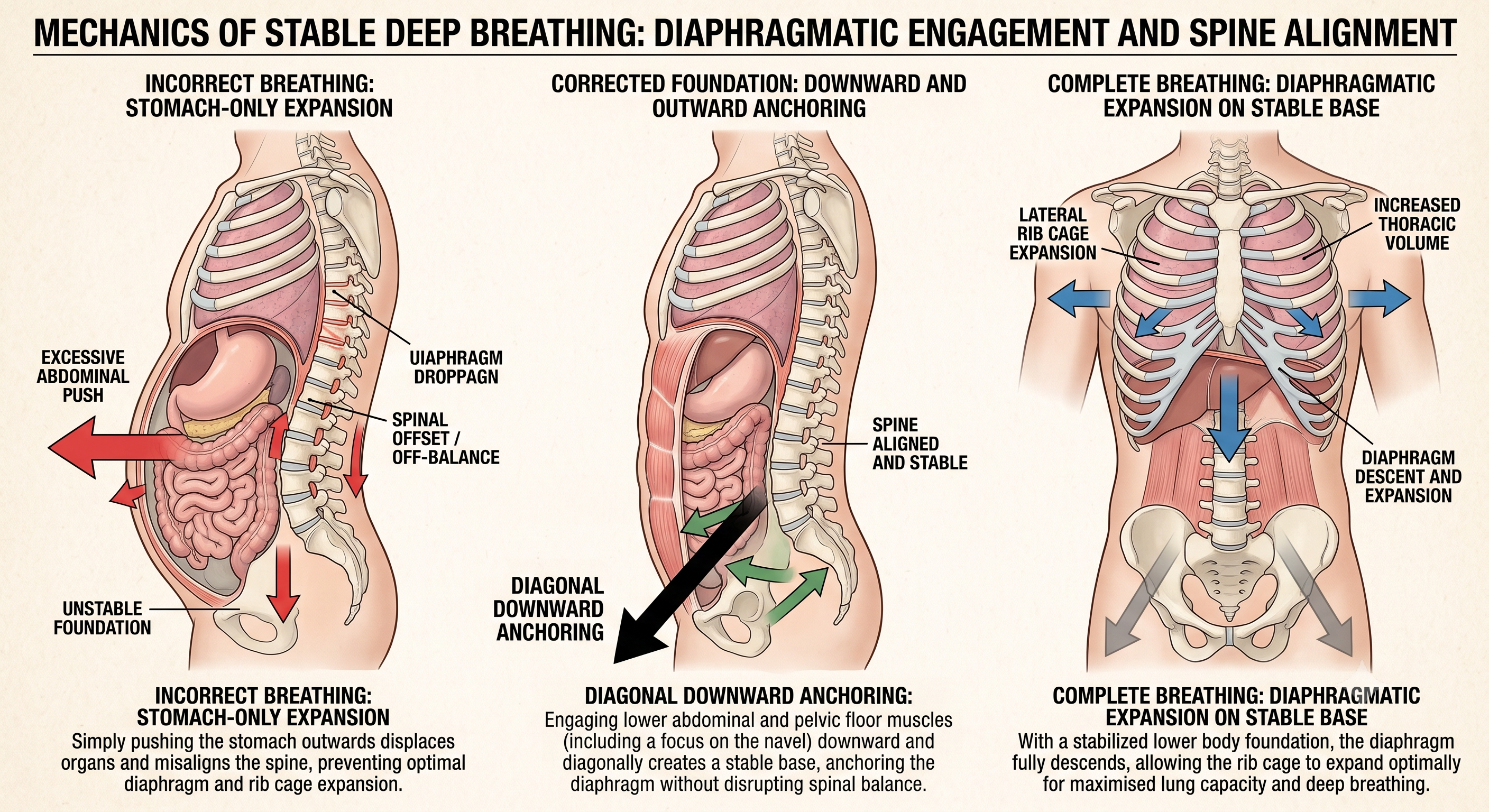
However, a common mistake when learning “deep breathing” is over-emphasizing belly expansion. Pushing the belly out excessively destabilizes posture. It encourages the lower spine into an exaggerated curve (lordosis) and increases anterior pelvic tilt in order to achieve this expansion. While belly expansion is the foundation of breathing, the air must also move upward. As the breath finishes filling, the lower ribcage must expand 360 degrees (outward, laterally, and posteriorly) to fully engage the diaphragm.1
The Key Heuristic
-
Expand the Nabhi (Belly Button): Direct the breath out and down at a minimum 45° angle (this is a felt cue, rather than a literal instruction). The goal is more downward pressure into the pelvic floor than outward push against the belt line. Prioritize downward motion over pushing outward.
-
Expand the Ribs: Once the belly feels appropriately filled, allow the lower ribcage to expand in all directions.
Another mental model
This can actually be simplified using a simple cue. Instead of pulling air up through the nostrils, pull air either (a) directly back or (b) at an angle (I find this second cue works better for tratika meditation). You feel the nose open fully as well as the throat. As a cascade effect, the diaphragm also opens up. A single cue thus executes all the required movements.
Standing
- Bend the knees
- Lightly strike the floor from the heels
Singing
When close to the end of the breath, the abs will be tight. Let go suddenly and a “breath” will automatically be taken. This is good for the when you only have a microbeat to take a breath.
Open-Ended Questions
- How to not run out of breath while walking?
- How to maintain a natural breath while exercising?
- Mechanics of breathing while singing? ✅
- It’s not as effective standing up as sitting or laying down. That must have some added dimension to it.✅
- control of exhalation is more difficult than inhalation.
Footnotes
Footnotes
-
For simplicity, this explanation treats the physical breath (driven by the diaphragm, which meets the solar plexus) and prana (the subtle energy that descends to the nabhi) as part of a single continuous process. I also blur the distinction between coaching cues and physical phenomena in the interest of a simple heuristic. ↩